
The two-week AI promise is missing the point
The promise of AI implementations in weeks is everywhere. But while technology can be deployed quickly, business value is rarely created at the same speed. In this article, our CEO Gijs Martens explores why successful AI adoption is about much more than configuration and go-live dates and why organisations should focus less on speed and more on building lasting capabilities that drive measurable impact.

Over the last few months, I have noticed an increasing number of AI propositions promising organisations a faster route to transformation. A fixed price, a short timeline, an AI-assisted implementation and the promise that you can be live in a matter of weeks.
I understand why that message resonates. The market is moving quickly, leaders feel pressure to act and nobody wants to be the company that is still discussing AI while competitors are already experimenting with it. Speed matters, efficiency matters and of course, AI can help us work faster.
Confusing implementation speed with business impact
But I also believe we need to be careful. Because in the rush to move quickly, we risk confusing implementation speed with business impact. Going live has never been the same as creating value. It simply means the system is available. Users may have access. The technology may be switched on. The demo may look impressive. But the real question is whether anything has meaningfully changed in the organisation.
Are employees working more effectively? Are customers being served better? Are decisions being made with more confidence? Are costs going down or revenues going up? Is the business genuinely improving? That is where AI becomes more complex than many short-term propositions suggest.
Going live is not the same as creating value
Modern AI tools can configure, generate and accelerate. They can support implementation teams, reduce repetitive work and help create first versions faster than before. That is valuable, and we should use it. But AI does not automatically understand the specific dynamics of your business. It does not replace years of implementation experience, domain knowledge or organisational context. It does not know how your people work, where adoption might fail or which process exceptions matter most to your customers.
In other words: an AI agent can be configured quickly. A business capability cannot.
The most successful digital transformations are rarely remembered because they went live quickly. They are remembered because they created lasting business outcomes. The same applies to AI. Technology may be the enabler, but value is created when people, processes and technology work together.
“The most successful digital transformations are rarely remembered because they went live quickly. They are remembered because they created lasting business outcomes.”
The model is not the differentiator
A recent article by Microsoft CEO Satya Nadella (‘A frontier without an ecosystem is not stable, June 14th 2026’) made a point that resonated strongly with me. The long-term value of AI will not simply come from choosing the best model. The real advantage will come from the systems organisations build around AI: the knowledge they connect, the workflows they redesign, the people they involve and the feedback loops they create.
That mirrors what we see in practice. Almost every organisation now has access to powerful models. Claude, Chat GPT, Gemini and whatever comes next will continue to improve. But if everyone has access to increasingly powerful technology, the technology itself cannot be the differentiator. What remains unique is the knowledge inside your organisation.
Your customer relationships,
Your expertise,
Your operating model,
Your data,
Your way of solving problems.
The real value of AI is not found in the model. It is found in how effectively you combine that technology with the experience and knowledge your organisation has built over many years. That is not something a model can generate for you. It is something your organisation has to contribute itself.
Why bolt-on AI often falls short
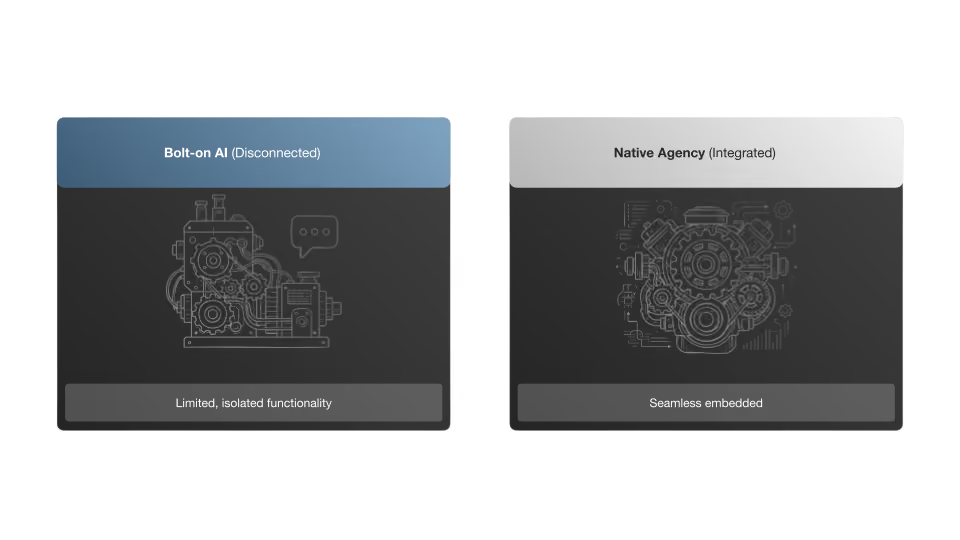
At Gen25, we often describe this challenge as the Bolt-on AI Trap. Many organisations have responded to AI by adding it to existing systems, a chatbot here, a copilot there. A search assistant somewhere else. These initiatives often generate excitement because they demonstrate what AI can do. But once the novelty wears off, a more important question emerges: what actually changed?
Many of these solutions can answer questions, summarise information or generate content. They have a voice. But they do not fundamentally change how work gets done. The process remains the same. The organisation remains the same. The customer experience remains largely unchanged. The result is AI that talks about work rather than AI that performs work. These are the solutions who pop-up, surf the trend of the moment and disappear silently after a period of time, when the sound is dimming down.
At Gen25, we believe the next phase of AI is not about giving technology a voice. It is about giving it a meaningful role within business operations. That means moving beyond disconnected use cases and embedding AI into the workflows where value is actually created, with reliable solutions who will stand the test of time. That is where the conversation shifts from experimentation to transformation.
AI needs more than configuration
This is also why we need to start thinking differently about AI agents. Too often they are treated as software features. In reality, they are much closer to digital labour.
If you hire a new employee, you do not judge success by whether they showed up on the first day. You define responsibilities, establish expectations and measure performance. You provide context, guidance and feedback.
The same should apply to AI. An agent should have a clear purpose. It should have measurable outcomes. It should understand the boundaries within which it can operate. It should know when to act independently and when to escalate to a human.
Without that structure, organisations may deploy AI quickly, but they will struggle to trust it at scale. The conversation should therefore not start with the question: "How quickly can we implement an AI agent?" It should start with: "Which business outcome are we trying to improve?" Only then does the technology become meaningful.
Adoption is where value is won or lost
One of the biggest lessons from digital transformation projects over the past decades is that implementation is often easier than adoption. You can activate a system in a day. You cannot create trust in a day.
Employees need to understand when AI can help and when human judgement is still required. Managers need confidence that outcomes are reliable. Customers need assurance that service quality remains high. Without that trust, even the most advanced AI solution will struggle to create impact.
People will ignore it, bypass it or create workarounds. This is why governance, change management and adoption remain critical ingredients of every successful AI initiative. Ironically, they are often the first things overlooked when the conversation becomes entirely focused on speed.
The risk of focusing on speed alone
The promise of being live in two weeks sounds attractive. And in fairness, modern AI tools can dramatically accelerate parts of an implementation. But organisations should be careful not to mistake speed of configuration for speed of value creation.
An AI agent can be configured quickly. Trust cannot, same goes for adoption, governance, and business alignment. Those elements determine whether AI becomes a lasting capability or simply another technology experiment. The risk is not that organisations move too fast, it’s that they optimise for the wrong outcome.
Building capability instead of projects.
The organisations seeing the greatest success with AI are approaching it differently. They are not treating AI as a project with a start and end date. They are treating it as a capability, something that evolves over time, that learns and becomes more valuable as more business knowledge, where data and experience are incorporated into it.
Every interaction generates insight, every workflow creates feedback and every outcome helps improve the next one. The objective is not simply to deploy an agent. The objective is to build an organisation that continuously becomes smarter. This requires business ownership, governance, adoption and a clear focus on measurable value creation.
A better question for leaders
Whenever I hear ambitious promises about rapid AI implementations, I find myself coming back to one simple question. Not: "How quickly can we go live?" But: "How quickly can we create measurable value?"
Because value is ultimately what matters. The organisations that will succeed with AI over the coming years will not necessarily be the ones that implement the fastest. They will be the ones that successfully combine technology with human expertise, organisational knowledge and a clear understanding of the business challenges they are trying to solve.
That is how AI becomes a capability instead of a project and that is where lasting competitive advantage begins.
Read more about how Gen25 accelerates businesses with AI here.


