
Dreamforce 2026 recap: The Agentic Enterprise
Salesforce is moving beyond the browser. Here's what AIforce, Koa and the new Agentforce agents mean for enterprise leaders.
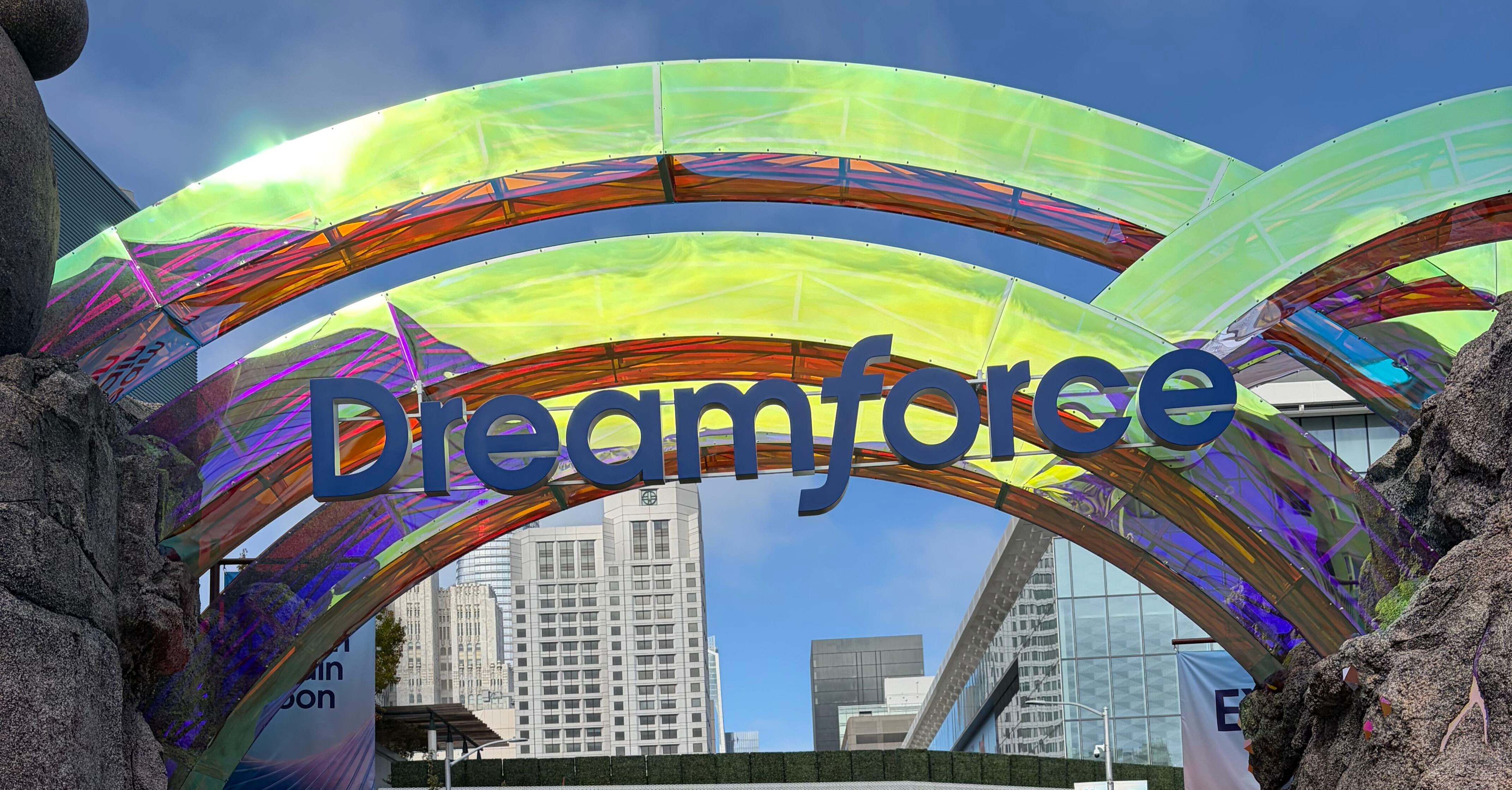
Every few years, the enterprise technology landscape experiences a structural pivot. At Dreamforce 2026 in San Francisco, Salesforce made a bold statement: the traditional Salesforce CRM web interface is no longer the center of gravity…
For over twenty years, using Salesforce meant logging into a browser, navigating custom record layouts, and manually executing steps. Now, their enterprise software is transitioning to the Agentic Enterprise - this means you can have workflows acting on your data and metadata, while maintaining your security permission, in your environment of choice!
Here is our breakdown of what was unveiled at Dreamforce 2026 and how enterprise leaders can translate these updates into measurable business value.
AIforce & Headless360
The headline announcement of Dreamforce 2026 was AIforce, a live, composable interface layer sitting above Data360 and Customer360. AIforce decouples Salesforce capabilities from fixed screens, enabling employees and autonomous AI agents to query records, execute business logic, and manage workflows from wherever they work - without necessarily logging into the Salesforce UI.
Powered under the hood by the Headless Toolkit and open Model Context Protocol (MCP) standards, AIforce exposes platform security, sharing rules, and validation logic to third-party environments:
- Claudeforce: Integrates Salesforce capabilities natively into Anthropic’s Claude interface via MCP servers, allowing sales and service teams to conduct account reviews and pipeline planning conversationally.
- Slackforce: Deepens Slack’s role as the conversational digital HQ, bringing interactive CRM widgets, Slackbot intelligence, and automated background actions directly into team channels.
- Agentforce Coworker: An embedded AI assistant inside the native Salesforce Lightning interface designed to reason across complex record sets and delegate long-horizon tasks to specialized background agents.
This means less time will be spent navigating between browser layouts. Salesforce can meet users directly in Slack or Claude, while maintaining centralized governance and object-level permissions behind the scenes.
The Koa Architecture
General-purpose frontier LLMs often struggle with complex, rule-bound CRM logic like territory hierarchies, dynamic escalation matrices, and complex revenue schedules. To solve this, Salesforce introduced Koa, its first purpose-built CRM reasoning model post-trained with NVIDIA on the Nemotron 3 Super architecture.
Koa is optimized specifically to reason across enterprise CRM metadata and business logic within Salesforce’s trust boundary. By executing inference internally with zero data retention, Koa reduces enterprise dependence on external third-party model APIs while delivering higher accuracy on domain-specific CRM tasks.
Koa should not be read as a replacement for the Atlas Reasoning Engine. Atlas remains Agentforce's orchestration layer, handling topic classification, grounding, tool invocation and Trust Layer checks; while Koa is a new CRM-tuned model that plugs into Atlas's reasoning step as an alternative to the existing default and third-party models.
Can Your Clouds Work Together?
A notable strategy shift at Dreamforce 2026 was major infrastructure and data-sharing expansions across hyperscalers. For customers, the practical benefits include:
- Google Cloud: Salesforce information and actions will be available inside Google's Gemini Enterprise, and there will be less need to copy data between Salesforce and Google BigQuery. Salesforce will also be hosted on Google Cloud, with North America availability planned for November 2026.
- AWS: Salesforce can work with more of the data you already keep in AWS without moving it. Customers also get a wider choice of AI models, Salesforce is coming to Amazon Quick, and IT teams can work with AWS infrastructure assistants directly in Slack.
At Gen25, we have long maintained that real enterprise transformation requires a connected multi-cloud stack. The open protocol bridges established between Salesforce, AWS, and Google Cloud validate this approach, enabling non-siloed data architectures across the enterprise.
The Digital Workforce
Moving past generic conversational prompts, Salesforce introduced seven pre-configured, Agentforce agents designed to handle autonomous workflows across key business functions:
- Casey: Customer service resolution across Voice, SMS, WhatsApp, and Web Chat.
- Piper: Inbound lead qualification and engagement (developed by Qualified, acquired by Salesforce in 2026).
- Hunter: Outbound sales pipeline generation and target account research.
- Paige: Internal IT and HR service request fulfillment.
- Marshall: Supply chain and back-office operations coordination.
- Fin: Handles complex customer experience workflows (from Salesforce's 2026 acquisition of Fin, formerly Intercom)
- Carter: In-chat digital commerce and product discovery.
Supported by multi-agent orchestration and long-horizon runtime capabilities, these specialized agents can pass context and tasks back and forth across departments without manual handoffs.
The Gen25 Perspective: How to Prepare Your Org
While headless interfaces and autonomous agents offer significant efficiency gains, successful implementation requires foundational work. Before deploying AIforce or Agentforce in production, business and IT leaders must address three core pillars:
- Data Harmonization (Data 360): Autonomous agents and reasoning models depend entirely on structured, unified, and real-time customer data. Eliminating data silos is step zero.
- Permission Architecture Audits: Because AIforce exposes Salesforce data via APIs and MCP servers to external tools like Claude or Slack, legacy user permissions and sharing rules must be rigorously audited.
- Process Alignment: Automation amplifies existing process design. Define precise guardrails, clear human-in-the-loop escalation paths, and key performance indicators before delegating tasks to autonomous agents.
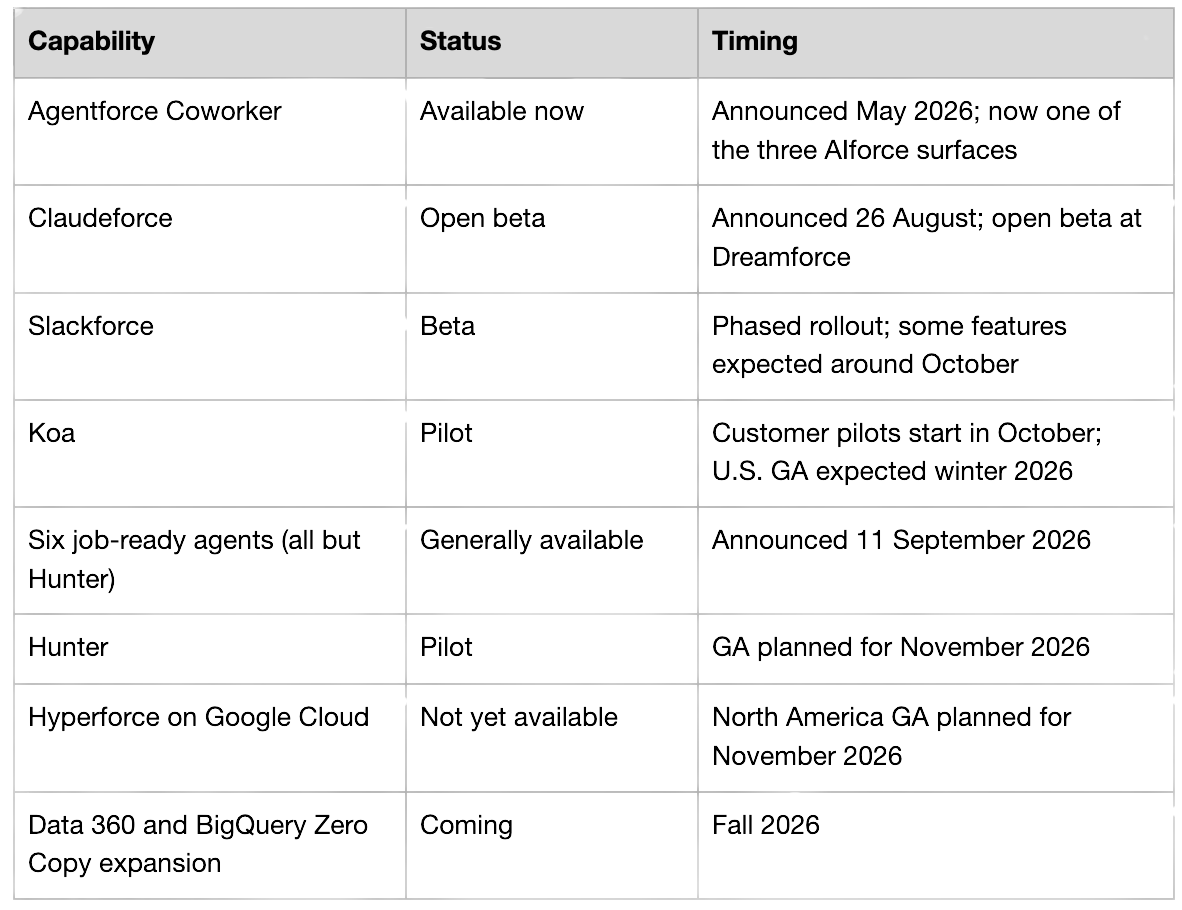
Availability at a Glance
Many Dreamforce announcements are still rolling out. This overview reflects what was publicly stated at the time of writing.
How Gen25 Can Help
Gen25 bridges business strategy with technical execution across Salesforce, AWS, and Google Cloud. Whether you are planning an AI Readiness Assessment, building a proof-of-concept for AIForce, Claudeforce or Agentforce, or architecting a Headless / MCP multi-cloud data strategy, our team helps you move from vision to measurable ROI.
Ready to evaluate what AIforce and multi-cloud AI mean for your enterprise stack? Connect with the Gen25 team here to map out your agentic AI roadmap.


